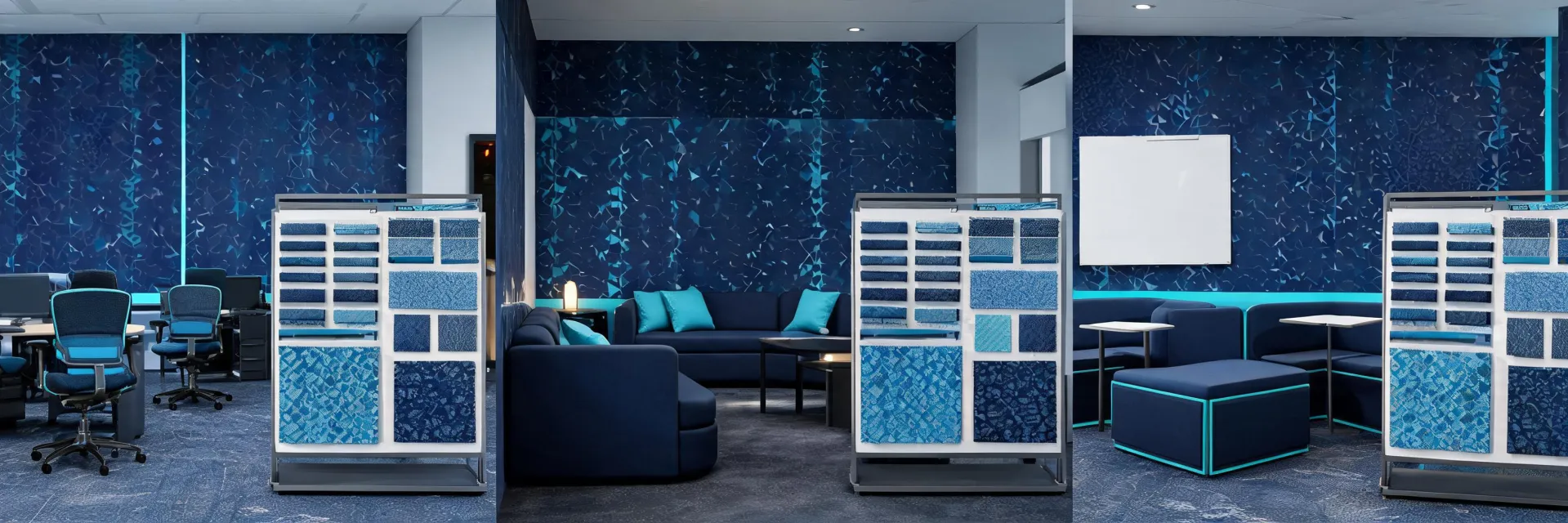
Commercial interior material boards for four applications

Application stories / IND-D

Momentum Textiles across commercial interiors

Application changes the review question. A pattern used on seating, a vertical panel or a wall does not inherit one universal cleaning, installation or performance requirement.

Horizontal application scan

Four settings, four evidence paths

Momentum's official site lists workplace, healthcare, hospitality and education markets. The scenarios below describe selection checkpoints, not named customer projects or measured outcomes.

01 / Workplace

Shared seating and vertical surfaces

Map traffic, task type, cleaning practice, daylight exposure and replacement access. Upholstery abrasion data may inform a discussion, but an abrasion figure alone does not predict appearance retention or service life.

  • Pattern scale at seating modules
  • Colorfastness method and exposure
  • Cleaning route for the named item
02 / Healthcare

Care routines meet material limits

Identify the facility's cleaning chemistry and frequency before selecting a surface. A product-specific claim must preserve the cleaner ratio, contact method and current care instructions instead of becoming a broad “healthcare grade” label.

  • Exact cleaner compatibility
  • Seam and substrate context
  • Current flame and care documents
03 / Hospitality

Layered visual and maintenance demands

Coordinate upholstery, drapery and wallcovering by visual intent while reviewing each construction separately. Repeat, railroad direction, backing and installation guidance can change estimating and detailing even when colors align.

  • Repeat and roll direction
  • Pattern placement and lighting
  • Area-specific maintenance plan
04 / Education

Frequent use, varied touch points

Classrooms, libraries and common spaces create different contact and maintenance patterns. Ask which published method applies to the selected pattern and whether the specified assembly changes the relevance of that result.

  • Use-zone distinction
  • Product versus assembly evidence
  • Replacement and care access

Decision scenarios, not customer claims

Where a specification can drift

Each scenario shows a background, review process and bounded conclusion without inventing an installation, buyer name or quantified result.

Scenario A

One collection, multiple surfaces

Background: a coordinated interior palette includes seating and wall surfaces. Process: the team separates upholstery composition, backing and care from wallcovering substrate, repeat and installation guidance. Conclusion: visual coordination can remain while the specification records two different evidence paths.

Scenario B

A compelling abrasion number

Background: a high cycle value appears on a product sheet. Process: the evaluator records the method, specimen and official caution, then checks seam design, maintenance and appearance expectations. Conclusion: the number supports a bounded comparison; it does not establish lifespan.

Scenario C

Cleaning language crosses a pattern line

Background: care guidance for one coated textile is repeated for a related item. Process: the team returns to the exact pattern and current care document. Conclusion: only the named product's procedure enters the project record.

Define the evidence gap

Bring the room, surface and exact pattern together.

Tell us whether the decision concerns upholstery, drapery or wallcovering, and name the document or method that needs clarification.